Bioanalytical Strategies for Antibody Drug Conjugate Development
Purpose
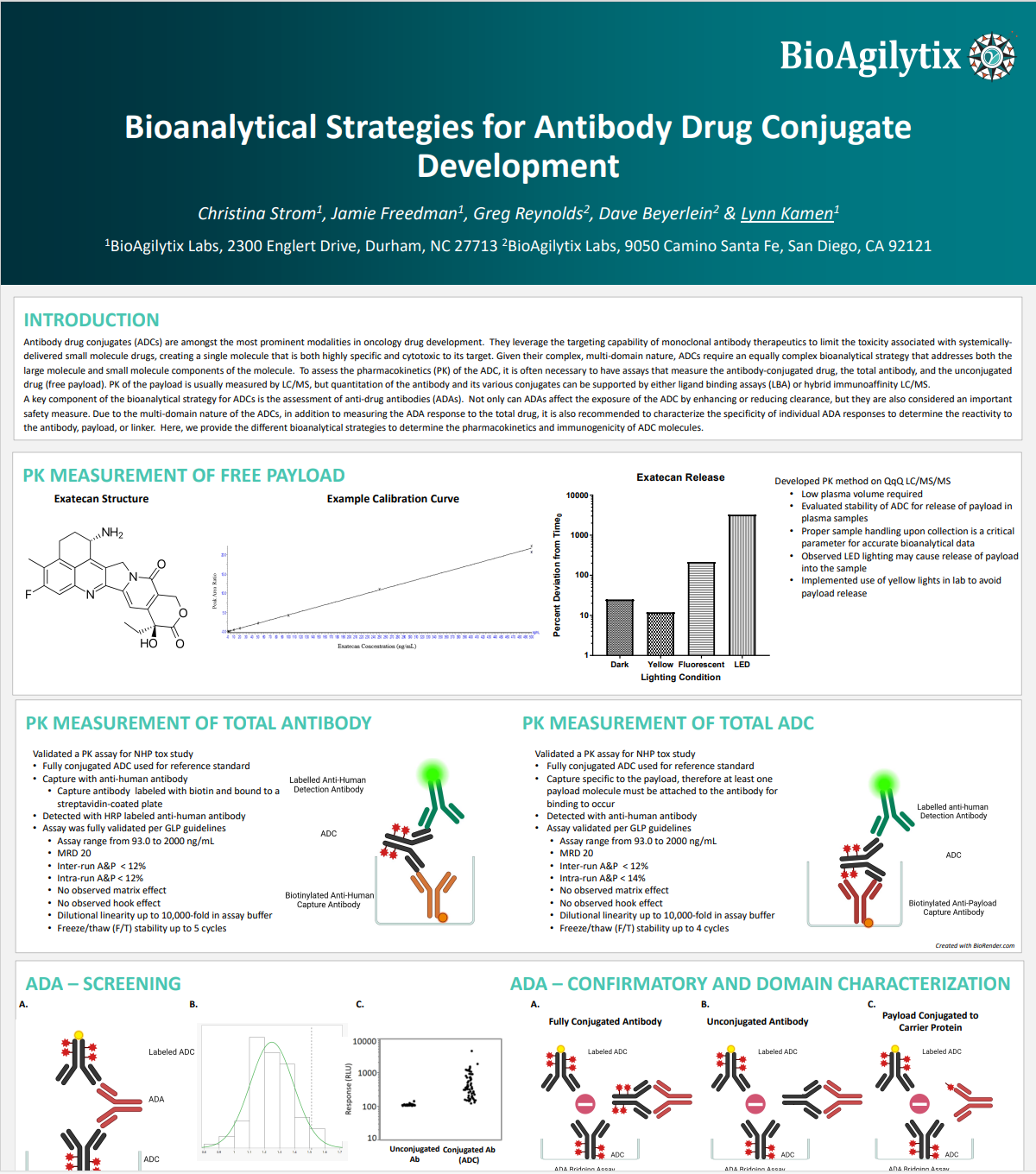
Antibody drug conjugates (ADCs) are amongst the most prominent modalities in oncology drug development. They leverage the targeting capability of monoclonal antibody therapeutics to limit the toxicity associated with systemically delivered small molecule drugs, creating a single molecule that is both highly specific and cytotoxic to its target. Given their complex, multi-domain nature, ADCs require an equally complex bioanalytical strategy that addresses both the large molecule and small molecule components of the molecule. To assess the pharmacokinetics (PK) of the ADC, it is often necessary to have assays that measure the antibody-conjugated drug, the total antibody, and the unconjugated drug (free payload). PK of the payload is usually measured by LC/MS, but quantitation of the antibody and its various conjugates can be supported by either ligand binding assays (LBA) or hybrid immunoaffinity LC/MS. A key component of the bioanalytical strategy for ADCs is the assessment of anti-drug antibodies (ADAs). Not only can ADAs affect the exposure of the ADC by enhancing or reducing clearance, but they are also considered an important safety measure. Due to the multi-domain nature of the ADCs, in addition to measuring the ADA response to the total drug, it is also recommended to characterize the specificity of individual ADA responses to determine the reactivity to the antibody, payload, or linker. Here, we provide the different bioanalytical strategies to determine the pharmacokinetics and immunogenicity of ADC molecules.
Bioanalytical Strategies for Antibody Drug Conjugate Development
Share this Article


 Copied!