Development of a Novel Sample Pretreatment Method to Optimize Drug Tolerance and Maintain Sensitivity for Immunogenicity Assessment of Biotherapeutics – WRIB 2025
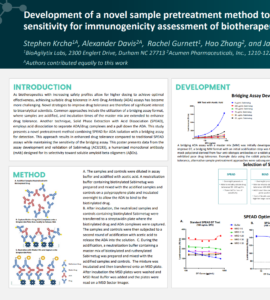
As modern biotherapeutics with improved safety profiles are administered at higher doses to achieve optimal therapeutic effectiveness, it becomes increasingly difficult to achieve suitable drug tolerance in anti-drug antibody (ADA) assays. Traditional techniques for mitigating circulating drug interference in immunoassays, such as bead extraction acid dissociation (BEAD) and PEG precipitation and acid dissociation (PANDA)-based assays can be prohibitively expensive, require specialized equipment, and demand specific training. Therefore, novel strategies to improve drug tolerance are of significant interest for bioanalysis. Here, we present a novel sample pretreatment method that combines solid phase extraction with acid dissociation (SPEAD) for ADA isolation with a bridging assay for detection.
Background
The industry needs accurate immunogenicity assessment methods that are robust and meet regulatory expectations for suitable assay sensitivity and drug tolerance. Common approaches for enhancing drug tolerance in immunogenicity testing include the optimization of the bridging assay format with increased master mix (MM) incubation times or addition of acid dissociation. Another established technique, SPEAD, employs acid dissociation to separate ADA/drug complexes and isolate the ADA in the sample.
It was hypothesized that combining SPEAD for ADA isolation with a bridging assay for detection would result in enhanced drug tolerance compared to traditional SPEAD assays while maintaining the sensitivity of the bridging assay. This hybrid methodology was applied to a monoclonal antibody therapeutic that required drug tolerance in the ADA assay in excess of 400 mg/mL.
Assay Development
Bridging Assay Development
The initial bridging ADA assay developed with an MM format demonstrated suboptimal drug tolerance of only 25 μg/mL. To improve drug tolerance, a bridging MM format with an initial acidification step was tested using either 333 mM acetic acid or 0.5M glycine. The resulting assay was tested using either a mock polyclonal derived from four anti-idiotypic antibodies or a rabbit polyclonal as a surrogate positive control (SPC). While this approach showed acceptable sensitivity, it still exhibited inadequate drug tolerance. Alternative sample pretreatment approaches were subsequently explored.
SPEAD Optimization
A standard SPEAD approach was tested with 100 ng/mL SPC but failed to improve drug tolerance and showed specificity issues and low sensitivity in the presence of serum. Thus, an alternative format was developed, combining ADA extraction from the SPEAD method with the sensitivity and specificity of the MM bridging method.
The steps involved in this composite ADA detection strategy were:
- Acid dissociation and initial complex formation
The samples and controls were diluted in assay buffer and acidified with acetic acid to dissociate pre-existing ADA-drug immune complexes. A neutralization buffer containing biotinylated drug was prepared and mixed with the acidified samples and controls on a propylene plate and incubated overnight to allow the free ADA to bind to the biotinylated drug.
- Solid phase extraction and second round of acid dissociation
After incubation, solid phase extraction was performed by transferring the neutralized samples and controls containing biotinylated drug to a streptavidin plate where the biotinylated drug and ADA complexes were captured. The samples and controls were then subjected to a second round of acidification with acetic acid to release the ADA into solution.
- Bridging assay detection
During this second acidification, a neutralization buffer containing an MM of biotinylated and ruthenylated drug was prepared and mixed with the acidified samples and controls for bridging detection. The mixture was incubated and then transferred onto a Meso Scale Discovery (MSD) Gold streptavidin plate. After incubation, the MSD plate was washed and MSD Read Buffer was added. The plates were then read on an MSD Sector Imager.
Results
The hybrid assay was validated using samples from 51 treatment-naïve disease state individuals. The validation data demonstrated superior performance compared to traditional SPEAD or bridging assays alone and met all validation parameters including:
Sensitivity: The assay achieved a sensitivity of 8.68 ng/mL for the screening tier and 12.88 ng/mL for the confirmation tier.
Control Precision: The method showed good precision with acceptable coefficient of variation (%CV) values.
Drug Tolerance: The method achieved remarkably improved drug tolerance:
- Medium concentration positive control (1 μg/mL): Tolerated up to 1200 μg/mL of drug in both the screening and confirmation tiers
- 100 ng/mL SPC: Tolerated up to 1200 μg/mL in the screening tier and up to 600 μg/mL in confirmation tier
- Low positive control (30 ng/mL): Tolerated up to 50 μg/mL in the screening tier
Discussion
This novel approach strategically leverages standard laboratory equipment and commonly employed laboratory practices to overcome the limitations of existing methods, yielding significant improvements in ADA detection even in the presence of excess drug (up to 1200 μg/mL).
It also offers the following advantages:
- The liquid-phase capture approach facilitates optimal binding between the drug and ADA, minimizing potential steric hindrance that can occur in solid-phase binding.
- The use of the bridging assay format reduces the likelihood of interference from other serum components.
- Integration of ADA pull-down using SPEAD with the specificity and reliability of an MM bridging assay combines method robustness, ease of execution, adequate sensitivity, and cost-effectiveness.
Key Takeaway
Traditional assays often fail to detect ADAs when high concentrations of the drug are present in samples. The innovative combination of SPEAD for ADA isolation with a bridging assay for detection provides a cost-effective, robust method that significantly enhances drug tolerance while maintaining sensitivity. This hybrid methodology represents an important advancement in overcoming the challenges of detecting ADAs in the presence of high drug concentrations, which is crucial for accurate immunogenicity assessment of modern high dose biotherapeutics.
To learn more about optimizing drug tolerance while maintaining sensitivity for biotherapeutic immunogenicity assessment, contact us to speak to a BioAgilytix scientist.
Development of a Novel Sample Pretreatment Method to Optimize Drug Tolerance and Maintain Sensitivity for Immunogenicity Assessment of Biotherapeutics
Share this Article


 Copied!